Monday, July 11, 2016

Five reasons why you should invest in social customer service

If you're a business in 2016, chances are that you've invested time and resources into maintaining a social media presence, to promote your brand and engage with consumers.


But have you made the same level of investment into providing a dedicated customer service on social media?


Many brands, despite having a social presence, aren't investing the time and resources into providing a good customer service on those channels.


A report by NM Incite into the 'State of Social Customer Service' found that although nearly 1 in 3 social media users prefer to reach out to a brand via social channels instead of over the phone, only 36% of users with a customer service inquiry reported having it solved quickly and effectively.


14% of users reported the company engaging quickly but failing to solve their issue, and 10% never received a response at all.


The fact is that when brands are present on social media, users increasingly expect to be able to reach out to them there and receive an effective response.


Providing a timely and helpful response to customers is of huge benefit to a business, but failing to provide a good response or even engage with a consumer can be even more costly.


Many businesses are understandably wary of engaging with consumers on such a public forum, but social media customer service and care can be incredibly effective when handled properly, and it's well worth your time to make sure your business does it right.


To explain why, here are five big reasons why you should be investing in social customer service.


A cartoon graphic of three blue Twitter-style birds, tweeting an exclamation mark and a question mark in speech bubbles emitting from their beaks.Image by opensource.com, available via CC BY-SA 2.0


1) It's convenient


The idea that social media provides a faster response to customer service enquiries is not necessarily true, as this can depend on the complexity of the requests, the volume, and how well-equipped a company is to deal with them. But what it does provide is convenience.


As Guy Stephens wrote in the ClickZ Intelligence Social Media Customer Service: Best Practice Guide:


“People like to say that social is all about speed. I don't subscribe to that view. Telephone or email are in many respects probably faster, so there has to be something more about social. I think it may well be convenience and the fact that it the channel is not owned by the company.”


Chances are high your customers already spend a lot of time on social media. Last year, GlobalWebIndex found that the average person spends a total of 1.72 hours on social networks, accounting for nearly 30% of their daily internet activities. So it makes sense to engage your customers where they already are – especially given that…


2) People expect a response – and they like to be heard


Dale Roberts reported for ClickZ back in April that response rates for brand surveys have dropped from 20% to just 2% over the past 20 years. But while customers have a limited amount of patience nowadays for being surveyed, they absolutely still want to be heard; they're just using different channels to communicate with brands.


Research commissioned by Lithium Technologies in 2013 found that 53% of people who tweet at a brand expect a response within the hour. This figure shoots up to 72% when people have a complaint to make.


A vector graphic of a stopwatch, with the hand moving towards the '2' position.

Research by Lithium Technologies indicates that 53% of people expect a brand response on Twitter within the hour. | Image by ClkerFreeVectorImages, public domain image


When companies don't respond to customer messages within the expected time frame, 38% of customers were found to feel more negative towards the brand, while 60% were prepared to take action to express their dissatisfaction, from denying the brand their business to publicly shaming them on social media.


It's not all doom and gloom, however; the same study also found that when brands provide a timely response to customer concerns, 34% are likely to buy more from that company, 43% are likely to encourage friends and family to buy their products, and 42% are willing to praise or recommend the brand through social media.


3) A good impression counts for a lot


So as we've established, your customers are already present on social media and will most likely be communicating with your brand there as well. The way you respond in that situation can make all the difference to your brand's reputation and profile.


Social media has been a game-changer for customer service in that it makes brand-customer interactions much more public, making companies accountable for the way that they deal with customers.


This might seem daunting, but it also provides companies with a major opportunity to create a positive impression for their brand, and showcase their commitment to good customer experience.


Take British Airways, which managed to find an opportunity for humour in a customer's complaint on Twitter, while still taking the time to address their concerns:


Customers don't always take to social media to complain – many want to express their appreciation. It's always nice to get the good feedback as well as the bad, and the way that you respond to it can invite more of the same.


A long Twitter exchange between an American Air customer who has been flying with the brand since he was 6 years old. He thanks the airline for a fabulous flight, and American Airlines responds by saying,


4) Customer service makes a huge difference to customer retention


We've already seen that the kind of response customers receive on social media can make a big difference to how they feel and act towards a brand. But it isn't just about fending off a bit of negative feedback: the data shows that customer service as a whole can massively influence a customer's choice of brand.


According to data gathered by Zendesk, 40% of customers began purchasing from a competitor brand based on its reputation for great customer service, while 85% were willing to pay up to 25% more to ensure a superior customer service experience.


On the flip side, 82% of customers were found to have stopped doing business with a company due to poor customer service, while 95% of customers have taken action as a result of a bad experience. Of these, 66% wanted to discourage others from buying from the company.


There's an oft-repeated saying that retaining a customer is five times cheaper than acquiring a new one. While this has been disputed – and the exact figure is probably a lot more difficult to quantify – it's clear that investing in a good customer experience across all channels is an extremely worthwhile business decision.


And not making efforts to provide good customer service can be genuinely costly.


A picture of an outstretched hand with a bubble floating above it. Inside the bubble is a cartoon image of a person's head and shoulders, wearing a red jacket and tie.A customer in the hand is five times cheaper than a customer in the bush. Or something like that, anyway. | Photo by geralt, public domain image 


5) It can be beneficial for product research and marketing


As Matt Owen wrote in our 'Social Customer Service: Best Practice Guide',


“In addition to providing information, social media channels should provide an open space for customers to discuss issues they have with a product or service, and the more constructive businesses will see this as a valuable source of product feedback, which can guide their own internal focus and reduce wastage.”


Savvy brands have also found ways to turn customer feedback on social media into an opportunity to upsell products.


Take Marks and Spencer, whose social customer service representatives respond to customer questions and criticism by recommending them products that they might like, or making sure that the feedback they have is passed on to the relevant internal teams.


This makes customers feel like they are heard and that the brand values their feedback, while also making it more likely they will come back to buy a similar product, or an item which was previously out of stock, if the brand keeps the lines of communication open.


With all that in mind, there's never been a better time to start making a dedicated investment into good social customer service, and set yourself apart from competitors who aren't yet in the game.


And if you need any more guidance on how to give your customers the best possible experience on social, check out ClickZ Intelligence's report 'Social Media Customer Service: Best Practice Guide'.

Friday, July 8, 2016

Six ways Pinterest is becoming serious about visual search

Pinterest is transforming into a powerful visual search engine and its latest features hint of a promising future.


Pinterest isn't new in the social media industry, but there was always a feeling that it's underperforming, compared to its potential, especially in the ecommerce world.


This may change soon, as it is focusing even more on its search functionality and more specifically, on its effective visual search.


More than 2 billion searches are conducted every month on Pinterest, with people looking for inspiration, customised to everyone's unique taste and interests.


Personalisation and recommendation


Pinterest is building on 'idea search' and it's proud of its recommendation tool, based on the users' searches and interests. Pinterest stresses that recommendations are not powered by robots as “Pinterest is powered by people and the ideas they hand select.”Six ways Pinterest becomes serious about (visual) search


Its search function allows users to find exactly what they are looking for, while the recommendations predict the users' next clicks, depending on similar searches.


This helps users create new keyword matches, by adding new words to the initial search, reaching for the perfect match in fewer clicks than expected.


Six ways Pinterest becomes serious about (visual) search


As Pinterest users love searching for new products, decoration ideas, inspiration, graphics, a powerful recommendation makes the searching experience more effective and thus, more appealing.


Guided search


Guided search isn't new on Pinterest, but it was probably the turning point for the platform it years ago, when it began realising how search may be crucial for its growth.


Search guides allowed users to continue jumping from one result to another, in a logical sequence that kept bringing them closer to the exact match, making the discovery mode more useful and engaging.


Six ways Pinterest becomes serious about (visual) search


This meant a user could find a product even without searching for it directly, with Pinterest improving the personalisation to favour both users and brands.


Improved personalisation led to better search results and this eventually increased the engagement, as users realised that browsing is becoming both interesting and practical when looking for new products or ideas.


What's more, guided search is helping users understand how Pinterest's new search function works, encouraging them to make more descriptive searches in order to discover exact matches.


And of course, there's the case when users start exploring a search without having a specific pin in mind, which makes the next clicks more spontaneous, with Pinterest offering numerous options of further discovery with its suggestions.


Visual search through existing pins


Six ways Pinterest becomes serious about (visual) search


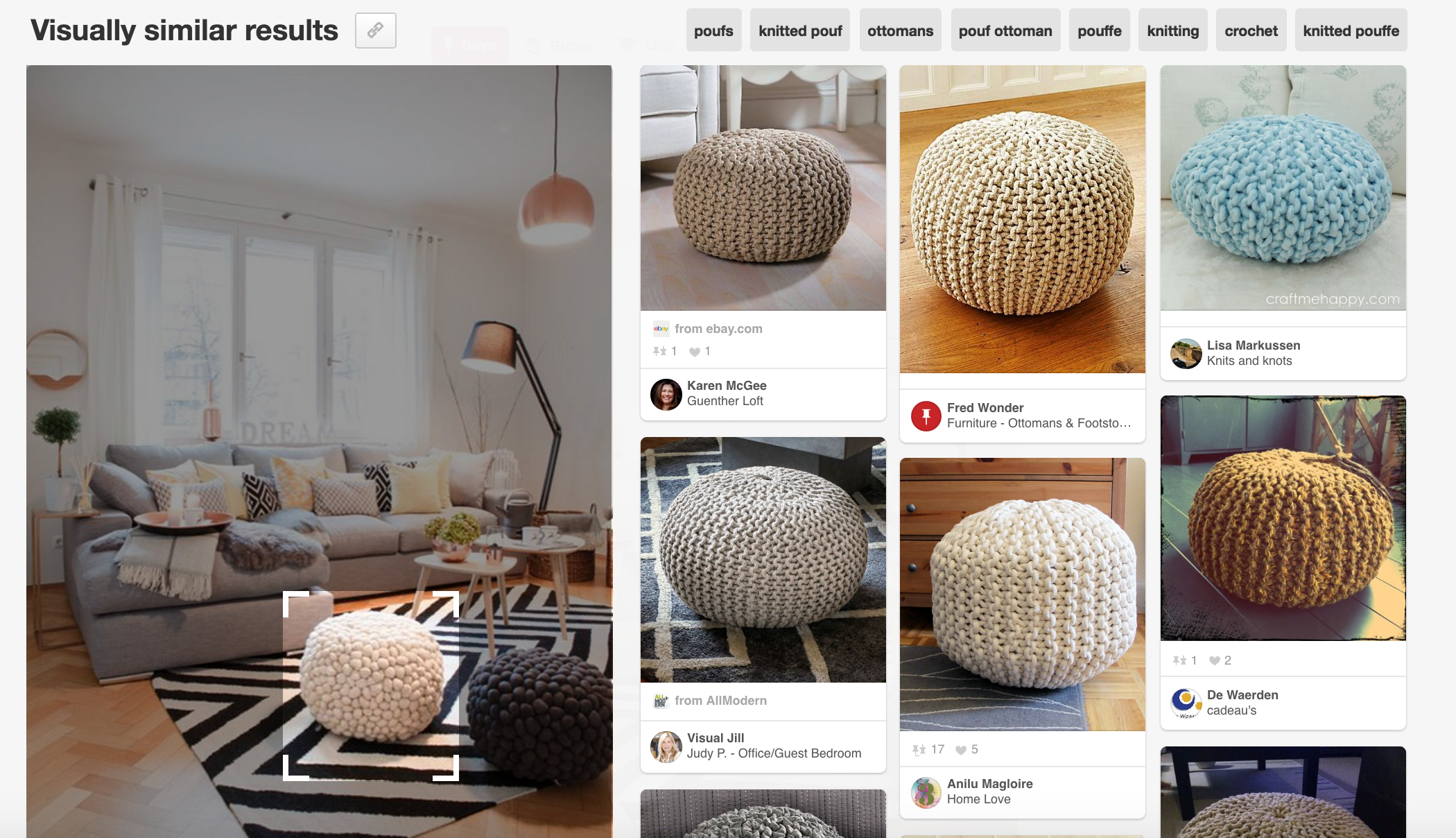
Pinterest introduced a way that you can discover any product that is depicted in an existing pin, by zooming on it and exploring all the similar related pins.


Let's say that you click on a pin showing a living room. If you like the specific lamp and you wish you could find a similar one, you just zoom-in on it and all of a sudden, you discover on the right side of your screen all the relevant pins that look similar to the particular lamp.


Six ways Pinterest becomes serious about (visual) search


This is extremely useful both for users looking for specific products, even buying them directly through the similar pins, but also for the actual retailers who have now found a new way to promote their products, by completely relying on personalisation and a targeted (and engaged) audience.


As you know that the specific user is interested in the specific lamp, your company can increase the sales of its product directly, by ensuring that it features all its products on Pinterest, in order to help users discover them.


Six ways Pinterest becomes serious about (visual) search


According to Pinterest, there are already 130 million visual searches that take place every month, with furniture, home decor and style ideas being the most popular ones.


Pinterest may not be the first tool that recognises products to find similar results, but this function makes it extremely powerful, especially when combined with an audience that can easily become hooked to the platform after a while, with a purchase intent that many sites would admire.


Image search meets the real world


Pinterest is not planning to rest upon its laurels, on the contrary, it seems to have bigger plans regarding visual search.


It was less than a month ago when it announced the arrival of a new camera search technology which will help pinners find the product they are looking for in the real world. A photo snap of an object will be enough to showcase similar recommendations on Pinterest, making the purchase of any product easier.


Six ways Pinterest becomes serious about (visual) search


This technology will take its visual search experience to the next level, hoping to maximise its commercial appeal, while brands will probably be excited to blend the real-world shopping experience with the relevant pins on Pinterest.


Local results


Six ways Pinterest becomes serious about (visual) search


Pinterest is also trying to favour local results, by creating pins that feature maps, by blending the location with Foursquare, while it also hopes that users will start discovering all the possibilities the platform may offer for the planning of their next trip.


These improvements on local search results led to three times more local ideas searched in the past year, while this also leads to further results which come twice as fast, helping everyone spot new places and options that are relevant to the initial search.


Six ways Pinterest becomes serious about (visual) search


Growing ad revenue – approaching search marketers


Pinterest is still struggling to monetise its whole experience, at least to the extent that we were expecting, and that's what has led to several recent changes, including the idea to offer keyword-based ad buys to search marketers.


Its search inventory is now available to advertisers, which will favour both its revenue, but also the marketers looking for more specific results, in an extremely targeted audience.


What's more, Pinterest has also collaborated with Acxiom and Epsilon to allow advertisers to combine their data with the platform's, in order to buy specific target audiences, in a similar way that Facebook does.


These are helping search marketers and brands to connect with their audience and reach them in new and more personalised way, which will make their messages more relevant and the conversion easier.


What's next?


Pinterest is hoping to increase its ecommerce features in the near future and it's time for brands and advertisers to start understanding its potential, along with the engaged audience that is ready to proceed to a purchase by the time the ideal product is found.


It's not easy yet for Pinterest to monetise its presence, but these recent features and the idea of focusing on visual search may help take it to the next level.

Thursday, July 7, 2016

Eight key improvements from an ecommerce site relaunch

Ecommerce site Simply Hammocks relaunched a few months ago, and has so far achieved some impressive results. 


The changes to the site have led to higher conversion rates and a 60% year on year increase in sales in the two months since relaunch.


The site, along with other brands from The Simply Group, was acquired last year by Scott Woodhead, who has founded other successful commerce sites, such as My Glasses Club and Loving Outdoors.


It seems that Simply Hammocks needed to work to bring it up to date and to speed (literally), hence the relaunch.


Here, I'll look at some of the changes made to the site as part of this process, and some of the early gains that have resulted.


Making the site mobile-friendly


Simply Hammocks has managed to increase mobile conversion rates from 0.06% to 2.3% by optimising for mobile.


Previously, the site wasn't mobile-friendly at all, so mobile users had to work hard to make it through checkout.


Here's the old version on mobile:


simply hammocks old mobile


And the new version:


IMG_2884


Optimising for speed


Site speed matters. It's about providing a better user experience, which in turn helps to improve conversion rates and reduce site abandonment.


brighton-seo-site-speed-for-content-marketers-4-638


(image taken from Tom Bennet's Brighton SEO presentation)


It will also be increasingly important for SEO, as Google is looking to make page speed a factor in its next mobile algorithm update.


According toThe Simply Group co-founder Scott Woodhead:


We ran all images through minify which saved us 1.4GB in file size. We moved over to Shopify which utilises Content Delivery Network and load balancing servers so the website was faster under traffic.


We also removed unnecessary apps. One in particular was from an installed module that wasn't being used but was loading javascript for each page from company that didn't exist. This added 3 seconds load to every page!


In addition, the homepage banner, which used to be a 16MB images,  was optimised for speed.


Social proof


Social proof can be very effective for ecommerce sites when used well. Here, Simply Hammocks has introduced pop-ups which appear to show which products other customers are buying right now.


They are relatively subtle pop-ups which don't interrupt the user, but instead gives people a gentle nudge.


They appear roughly every five to ten seconds (at least around 10am on a Monday morning) and give the impression that:


  1. People are buying from the site, which reinforces trust. If other customers are buying, then it must be OK etc…

  2. People are buying at regular intervals, which creates a sense of urgency.


popups


According to Scott, these pop-ups have increased conversions by 40% since implementation.


Improved product imagery


The importance of product images for online retailers shouldn't be underestimated, as they form a key part of the customer's decision on whether or not to make a purchase.


Here, the product pages have multiple images which allow potential buyers to see the product in context, as well as more practical shots which show a close up of the material, as well as the storage bag.


hammocks


The site has also added some quirky imagery – you'll see the odd tortoise or dropped ice cream on some of the product shots.


Previously, images were mainly garden shots, meaning that the category pages were a sea of green. This made it harder to individual products to stand out.


A focus on delivery


Delivery is a key part of the customer experience, and shoppers increasingly expect greater convenience in terms of shipping options and speed.


Indeed, a recent survey found that 42% of customers have higher expectations around delivery now than two years ago, with factors such as greater control a key issue.


ecommerce delivery user expectations


The site offers free express delivery, with all items shipped the next day. It displays the rate of next day arrivals (97%) at the top of the site as a sales driver.


delivery hammocks


Product page detail


Most of these hammocks are in the £70-£250 price bracket, and naturally customers want some detailed information before committing to buy.


To this end, there's plenty of detail about the products, including buyer's guides, detailed information on size and materials, as well as product videos.


product detail


The site also offers downloadable instruction manuals, useful for customers who may have misplaced theirs, but also a great SEO tactic, as people searching for manuals are likely to end up on this site.


As mentioned above, the product images and variety of views also helps to make the pages more effective than before.


An improved content strategy


There are some who would cast doubt on the value of blogging for online retailers, but it can be very effective when done well, and I've seen examples where relatively niche retailers can gain an advantage.


Content which directly addresses customer queries and concerns around products (such as how-to guides) can be very effective.


Here's an example, which answers a common customer question:


hammock blog


It's useful content for customers, but also helps pick up search traffic. The key thing here is that this content is targeting a key audience of potential hammock buyers.


Thanks to this content, the site ranks well for this query, and will continue to attract traffic for some time to come.


hammock seo


Smooth checkout


There's no forced registration, the checkout has been enclosed with distractions removed, and forms work well. All key factors in a successful checkout process.


hammock checkout


In summary


The site is a work in progress, but some of the key issues which affect conversion have been addressed already. The site is faster, works on mobile, product pages are effective, and the checkout works as it should.


There are more improvements planned, such as hammock buying tools, greater choice over delivery slots, and other social proof features such as showing items which are frequently purchased together.


The improvements here offer a lesson on the areas to prioritise when redesigning ecommerce sites, as well as the potential gains which can be made.


For more information on this topic, see our Ecommerce Checkout Best Practice Guide.


For more reports, including guides on mobile commerce, customer experience, and social customer service, head to ClickZ Intelligence. 

Tuesday, July 5, 2016

How to increase your content's viral potential

Viral content is sort of the holy grail of internet marketing; everyone wants it, but almost no-one knows how to get it.


Whatever it is that makes content inherently shareable – and, at the extreme end of the spectrum, go viral – seems like more of a mystical art than a science; a fortunate coinciding of different elements like timeliness, relevance and tapping into something in the wider consciousness that resonates with people.


But many researchers and marketers have set out to define, scientifically, what exactly it is that makes us share content?


What are the emotions and thought processes that are involved in the process of deciding to share something? And is there something inherently unique about viral content that makes it go viral, over another piece of content?


Fractl conducted a study aimed at discovering exactly that. They surveyed 400 people on their emotional responses to a set of viral images, using the PAD emotional state model to score their responses and determine how viral content resonates with us emotionally, as well which combinations of emotions are most likely to make content go viral.


A surprising result


The survey assessed respondents on their emotional responses to 100 of the top images from Reddit's /r/pics subreddit: 50 with captions, and 50 without. They were able to choose from a range of emotions belonging to the PAD emotional state model, a psychological model developed to describe and measure emotional states, to describe how they felt about the image presented in the survey.


The survey's respondents were English speakers from all over the world, and so the research team chose images which could be understood regardless of cultural background, avoiding references to pop culture or current events. Each of the images had thousands of upvotes and hundreds or thousands of comments, plus at least one million views on Imgur.


emotions survey


The list contained emotions ranging from love and admiration to relief, pity, remorse and hate. Although humour, a key component of viral imagery, is not represented by the PAD model, other emotions like happiness and satisfaction come close to expressing the same sentiment.


Andrea Lehr, brand relationship strategist at Fractl, said that the agency already knew that humorous content can create an “extremely positive emotional experience”, but that “we were interested in looking at more nuanced instances of viral content where it's not as clear why something became hugely popular.”


Fractl found that the top three emotional responses to the viral images in their survey were happiness, surprise and admiration.


A bar chart of top emotional responses to viral images, ranging from most to least expressed in the survey. Happiness is at the top with almost 7,000 responses, followed by surprise and then admiration. Next is satisfaction with a little under 5,000, then hope, love, happiness for (empathy), concentration, pride and finally gratitude with about 2,000 responses.


Negative emotions were reported far less than positive emotions, with the bottom three responses being hate, reproach and resentment.


A bar chart of the bottom emotional responses to viral images in the survey, ranging from least to most common. Hate is at the top with about 300 responses, followed by reproach and then resentment. Next is gloating with about 450 responses, then shame, anger, remorse, depression, annoyance and finally disappointment with about 800 responses.


These results for the most part match up with the findings cited by Kohlben Vodden, founder of StoryScience, in a talk at a CMA Digital Breakfast on the science behind shareable content.


Vodden noted, referencing a study by Jonah Berger and Katherine Milkman, that content with an overall positive sentiment will always be more shareable – hence the popularity of feel-good viral content websites like Upworthy and Thought Catalog.


However, Berger and Milkman also found that high-intensity negative emotions like anger also made content highly shareable.


This finding was not reflected in the study by Fractl, who found that anger was the sixth least likely emotion to be felt in response to the viral images they used, out of a possible 26 different emotional responses.


Complex emotions


Fractl's study also found that viral images are frequently emotionally complex, eliciting multiple emotional responses at the same time. Positive emotions along with surprise were found to result in massive shares – you only have to look at the recent 'Chewbacca mom' viral hit to see this in action.


As well as the initial emotional reaction, the survey asked participants to assess how pleasant each image made them feel, on a scale of 1 to 10. They were then asked to rate their levels of 'arousal' and 'dominance' in response to each image.


'Arousal' essentially measures the level of excitement and energy produced by emotions: anxiety, anger and excitement are high-arousal emotions, while sadness, relaxation and depression are low-arousal emotions.


'Dominance' measures the level of control that a person feels through their emotions. An emotion like anger is high-dominance, while fear is a submissive or low-dominance emotion, as it tends to result in feeling out of control.


Again, surprise was a recurring theme among the researchers' findings, which makes sense when you think about the natural of viral content: it often catches us out, is shocking or unexpected, which is what drives the urge to pass it along to everyone we know so that they can share in the amazement.


A photograph of cars driving along a road in stormy weather. In the distance is a pure white vertical beam of light streaking down from the clouds. The caption above reads,


The study found that images which made people feel high levels of dominance and arousal were all accompanied by positive emotions, or positive emotions plus surprise. For images which caused high arousal and low dominance, the emotional responses tended to combine surprise with negative and/or positive emotions.


For instance, this image of a diver taking a selfie with a great white shark behind produced high arousal and low dominance, with emotions ranging from fear and surprise to admiration.


A diver takes a selfie underwater with a great white shark clearly visible behind, appearing to be swimming towards him.


Low-arousal and low-dominance images resulted in a mixed bag of emotional responses, but surprise was almost always present. Boredom was also a frequent response to these images, indicating that not every surprising image is necessarily interesting!


How to increase your content's viral potential


So how can you put these findings into practice and increase the shareability of your content marketing? Fractl offered some key takeaways for marketers:


1. Combine positive emotions with surprise for huge sharing potential.


“Want people to share your content? Feel-good content is primed for social sharing,” said Fractl in their report on the results of the study. The research found that admiration and happiness had a strong correlation with high dominance, which helps drive people to share things.


Combining these with an element of surprise can help to magnify the positive emotions and spur users to pass along the content. With that said, the surprise needs to be genuine: clickbait headlines such as “You'll never believe…” which lead to unsurprising or boring content are quick to annoy users.


A headline from Wired magazine online reading, 'You'll be outraged at how easy it was to get you to click on this headline'.


2. Pair 'low-arousal' emotions with admiration or surprise.


If your content is a bit of a downer, incorporate an element of surprise or admiration to increase its viral potential.


Fractl had previously assumed that 'high-arousal' emotions like excitement or anger were needed for content to go viral. From the study, however, they discovered that negative, low-arousal images which evoked images like sadness and depression could still go viral when paired with surprise or admiration.


A good example of this technique is 'The Song', Apple's famed Christmas advert from 2014:


'The Song' pairs a sad and wistful story with elements of surprise, admiration and hope, for an uplifting after-effect that makes the advert eminently shareable.


3. Play up high-arousal emotions in unsurprising, negative content.


Generally speaking, an element of surprise is also needed to make high-arousal negative content more shareable: most of the images in Fractl's study which received negative reactions were also rated as surprising.


Only two images provoked purely negative responses, and both of those made respondents feel very high-arousal negative emotions: anger, fear or distress. Therefore, it is possible to have negative content which is still shareable if it energises people in some way; but overall, positive and surprising content is still the clear winner if you want your content shared widely.

Monday, July 4, 2016

Vida Divina Leads


via Work with Marvin

What can Medium's Creative Exchange bring to native advertising?

Last week, social publishing company Medium announced the launch of a programme that will allow its writers to partner with brands to create dedicated sponsored content: the Creative Exchange.


The Creative Exchange is by no means Medium's first foray into native advertising: in the past, it has produced a number of verticals in partnership with different brands, including BMW, Marriott and Samsung. But this is the first time that Medium has opened up native advertising for the wider community to take part in.


In its blog post announcing the new programme, Medium acknowledged that, “One of the things we've heard consistently is that our community wants a way to make money from their work on the platform. It takes effort to produce a piece of high-quality content and that effort should be rewarded.”


While this is undoubtedly true, the writers who called for Medium content to be monetised probably wanted the ability to earn money from the independent content they write, rather than to be paid to write sponsored content for a brand.


Still, there are no doubt plenty of others who will welcome the venture. But what can Medium contribute to the field of sponsored content, already crowded with publishers and platforms, that's particularly new? And what do brands stand to gain?


What can Medium bring to native advertising?


Medium has always been a slightly strange entity, whose exact nature is hard to pin down: it straddles the divide between publisher and network, between social and blogging; giving writers a space for their voice to be heard, but very much on Medium's terms.


“Medium's greatest asset is our community of writers and publishers,” the blog post which announced the Creative Exchange began. Clearly this is what Medium intends to be its main selling point as it expands its venture into native advertising: an established network of writers, many with huge followings, and readers who will eagerly consume writing published to the platform regardless of whether it is sponsored or not, as long as it is of the quality and type they have come to expect.


A screenshot of the top of a Medium sponsored piece entitled 'How to Rewrite Your Past, Present and Future'. At the very top of the page are the words 'life well lived' in gold and blue, while underneath the heading the text reads 'Presented by GUARDIAN' with the logo for Guardian life insurance.A piece of sponsored content on Medium, with branding clearly marked


Medium's blog post cites two past pieces of sponsored content as examples of what writing produced by the Creative Exchange is likely to look like. One is sponsored by Guardian, a life insurance company, the other by Upwork, a freelance marketplace.


Both are well-written and valuable pieces of content which don't read like advertising or even mention the sponsored brand by name (although they are both clearly marked as sponsored with logos above and below the piece).


Neither of them made me want to buy anything either, but then, the aims of native advertising are usually more subtle than that.


In many ways, Medium is exceedingly well-suited to native advertising, much more than other publishing platforms. For one thing, it's already heavily branded. Criticisms have been levelled against Medium for taking away creative control from writers who publish to its platform, denying them the ability to choose how their content looks and is offered to readers.


A screenshot of a Medium post by Rebecca Sentance, entitled 'Reflections on Liberating Corporate Data'. The post is laid out in simple, no-frills style, in black serif font with a wide margin either side. The Medium logo in grayscale is present in the top left corner.Publishing to Medium offers writers very little leeway, if any, to impose their own style on the content


The design, the layout, the branding is all very much Medium's; and so users who are happy with this arrangement are unlikely to object to a further level of branding being applied to their content. It seems unlikely that any devoted writers or readers, if they're content to use Medium as it is, will abruptly draw a line and say no, this amount of branding is a step too far.


So Medium can offer an engaged community of writers and readers among whom there is already a demand for some kind of monetisation, and an openness to sponsored branding. All points in its favour – but what else is Medium offering to brands in the deal?


How will brands benefit?


At the moment, Medium isn't opening up the Creative Exchange programme too widely to interested writers and publishers; the programme is currently in “closed beta”, and aspiring participants will need to add their details to a waiting list. But Medium is placing no such restriction on brands who want to take part. This makes sense, since Medium has writers in abundance, but the brands are where the real money lies.


Medium's approach to content publishing, that it simplifies the process by taking care of the unimportant details that no-one wants to concern themselves with (like design) is also the main thrust of its appeal to brands: it offers an all-in-one deal, “including writing, editing, project management, editorial strategy, publication creation, and publication branding.” In its bid, Medium plays up the fact that it can “manage the entire process for you, including publishing approved content from your brand account.”


A graphic of a brown box with parcel tape across the top, with

Medium's native advertising aims to offer brands the whole package

Image by OpenclipartVectors on Pixabay, available via CC0


This is likely to be an appealing prospect for brands who are new to native advertising or don't have the time or the resources to micro-manage every aspect of the project. However, as with writers who publish to the Medium platform, there are drawbacks in the form of ownership and control. Medium is coy about the subject of brands owning the content produced via Creative Exchange, saying only that, “We have several different licenses available. We'll work with you to meet your needs. Contact us for more information.”


There is a lot to be said for publishing to a platform which, as I covered above, comes with an in-built community of readers eager to consume that content. In many respects it puts Medium ahead of native ad providers like Outbrain and Taboola which have to depend on luring readers away from platforms where they are already reading content, with gimmicky headlines and psychological tricks.


A screenshot from the platform game Fez, featuring floating platforms against a bright blue backdrop, with square green trees on top of them.Brands are already faced with an overabundance of platforms demanding their content

Image via Wikimedia Commons, available via CC BY-SA 3.0


But there's a drawback to it, too: brands are already faced with an overabundance of platforms to which they could publish content, each with their own appeal. Medium boasts one engaged community of users, but Facebook has another, as does Twitter, and Google, and Snapchat, and every other contender which is throwing its hat into this expanding ring.


No matter how good the offer is, ultimately brands have to make a choice as to how many channels are worth spreading their presence across. And if they are a brand which already has an established presence on Medium, why pay for what they are already getting for free?


To an extent, Medium's all-in-one approach does solve that problem, by allowing brands to reach an extra audience without having to expend the time and effort that they would normally need to invest in publishing to a new platform: Medium will take care of all of that. But brands will still have to decide whether the exact audience they want to reach is present within Medium's walled garden, and if it isn't, they are likely to take their business elsewhere.

Tuesday, June 28, 2016

17 inspirational examples of data visualization

We can all collect masses of data, but it only becomes genuinely useful when we use it to make a clear point.


This is where data visualization comes in. Showing data in context and using creativity to make that same data tell a story can truly bring the numbers to life.


There are a whole bunch of data visualization tools out there to help create your own, but here are some existing examples for inspiration.


A day in the life of Americans


This excellent visualization from Flowing data uses information from the American Time Use Survey to show what Americans are up to at any time of day.


day


What streaming services pay artists


This from the wonderful information is beautiful website, looks at how the major online streaming music services compare in terms of paying the musicians.


streaming pay


Two centuries of US immigration


This fantastic visualization from metrocosm shows the various waves of immigration into the United States from the 19th century to the present day.


us immigration


US population trends over time


This gif from the Pew Research Center is a great example of how movement can be used to convey shifts and trends over time.


pew gif


Why you should take the bus


The German town of Münster produced this series of images back in 1991 to encourage bus use. It's beautifully simple showing the relative impact of the same number of people (72) on bicycles, in cars, or on a bus.


munster


What happens in an internet minute?


This infographic from excelacom presents what happens online in 60 seconds, including:


  • 150 million emails are sent.

  • 1,389 Uber rides.

  • 527,760 photos shared on Snapchat.

  • 51,000 app downloads on Apple's App Store.

  • $203,596 in sales on Amazon.com.


Excelacom_InternetMinute2016


US wind map


This moving visualization shows wind speed and direction in real time.


It looks great and is easy to understand, which is key to effect data visualization. This one comes from hint.fm.


wind map


Daily routines of creative people


I've always been pretty cynical about this 'X things successful people do before breakfast' stuff – as if by following this, people are suddenly going to become Steve Jobs or Albert Einstein.


However, this one from podio showing daily routines of creative people is very interesting. It won't turn you into a great composer, but it's a fascinating insight nonetheless.


routines


The impact of vaccines


This is a series of visualizations from the Wall Street Journal, which shows the impact of vaccines on various infectious diseases.


It's striking stuff, which clearly demonstrates the incredible positive impact of vaccination programs in the US.


vaccine impact


London food hygeine


This is a great use of freely available data to provide useful information for the public.


london hygeine


The one million tweet map


This uses tweet data to present a geographical representation of where people tweet about topics. The example below is for 'Brexit'.


1m tweet map


The fallen of WW2


This, from Neil Halloran is a cross between data visualization and documentary.


ww2


There are two versions of this. The video version you can see embedded below, and an interactive version.


People living on earth


A simple but very effective visualization of the world's population, and the speed at which it increases.


earth


The ultimate data dog


This, again from Information is Beautiful, uses data on the intelligence and other characteristics of dog breeds, plotting this against data on the popularity of various breeds from the American Kennel Club.


data dog


How much did band members contribute to each Beatles album? 


This from Mike Moore, shows the relative writing percentage for each Beatles album, as well as the contribution over time.


The Beatles


A day on the London Underground


From Will Gallia, who used data from a single day's use of the London underground to produce this timelapse visualization.


Fish Pharm


This is from way back in 2010, and illustrates the fact that antidepressants and other pharmaceuticals are now showing up in fish tissue.


fishpills